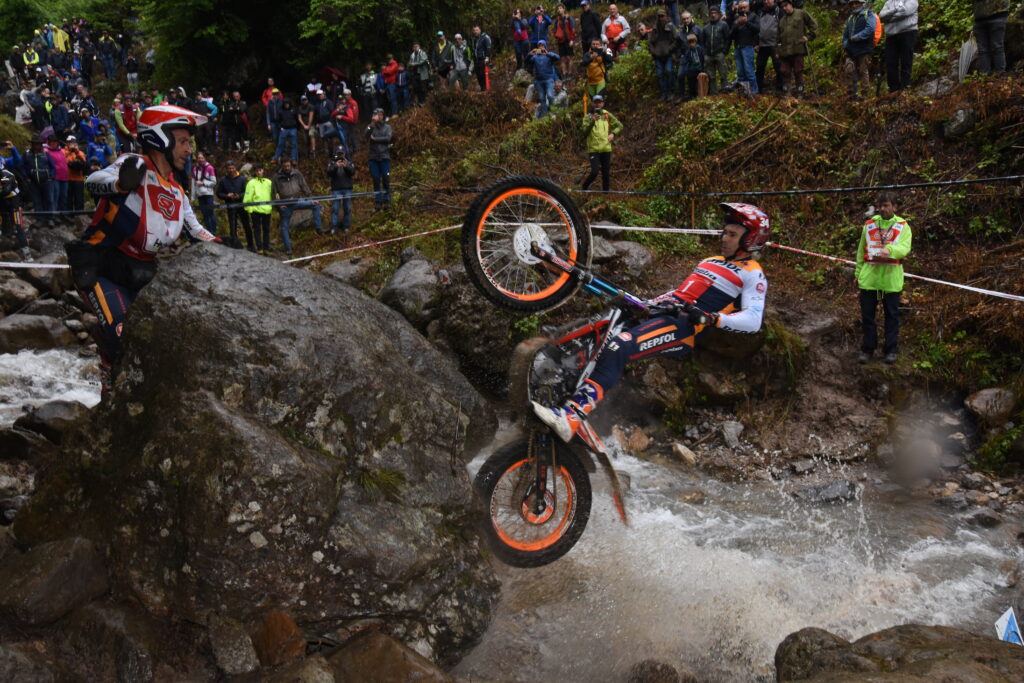
What is Motorcycle Trials? / Cos’è il Trial Motociclistico?
A motorsport centered on balance, where victory goes not to the first to cross the finish line, but to the rider who navigates obstacles with the greatest elegance—a discipline where, rather than battling elbow-to-elbow, riders challenge gravity, scaling vertical terrain that would be impossible to climb even on foot.
Elegance is measured in penalties, which riders incur whenever they touch their feet to the ground. They strive to avoid this within “sections” scattered along a loop. This loop is primarily off-road and varies in length from one event to another, ranging anywhere from 2 km to as much as 100 km. The winner is the rider who incurs the fewest penalties.
The skill lies in maneuvering the motorcycle—riding while standing, shifting one’s body weight appropriately, carefully modulating the throttle, and making the most of the suspension—to reach the end of the “section” while minimizing penalties, which are incurred by touching the ground or obstacles with one’s feet.
In each section, there are at least two “observer” tasked with assigning penalties. A section is defined as an off-road course—no more than about thirty meters long—marked off by tape, containing large rocks, steep climbs, or mountain streams. There is an “Start” sign and a “End” sign. Within the section, additional “gates”—marked by pairs of plastic arrows attached to rocks, trees, or specially placed stakes—guide the rider on the required path.
Competitors enter the section one at a time, having previously inspected it only on foot. Attempting to ride through it beforehand is strictly prohibited. The skill of the organizers lies in identifying natural terrain that is challenging enough to test the riders, yet not impossible to navigate.
The penalty system—which has evolved over time—is quite straightforward: a score of “0” is given if the rider does not touch the ground with their feet; “1” for one touch; “2” for two touches; “3” for three or more touches; and “5” if the rider falls, breaks the course tape or a marker arrow, moves backward while their foot is on the ground, or chooses to abandon the section, deeming it beyond their ability.
There are often different levels of difficulty, distinguished by the colors of the arrows that mark the gates within each section. In ascending order of difficulty, the sequence is white, yellow, green, and blue, with red representing the most challenging level.
Competitions can follow various formats: the most common consists of two laps through 10–15 zones. Another highly sought-after format involves a single lap through 20–30 unique sections—an approach that naturally requires a significant organizational effort. In smaller-scale events, the format may consist of 7–8 sections, which are then repeated three times.
We are referring to outdoor trials—the most common form—where competitions share fairly similar characteristics. Indoor trials, which take place inside sports arenas or in large public squares during the summer, are a somewhat different matter. In these events, the focus is on the spectator experience, with a small number of controlled sections all contained within a confined space. There is no loop between sections.
Lo sport dei motori dell’equilibrio, dove non vince chi arriva primo ma chi supera degli ostacoli con maggiore eleganza, dove i piloti non lottano gomito a gomito tra loro ma sfidano la gravità salendo in verticale dove non ci si arrampicherebbe neppure a piedi.
L’eleganza viene misurata in penalità a cui incorrono i piloti quando appoggiano i piedi a terra, cercano di non farlo nelle “zone controllate” dette anche sezioni, che sono disseminate su un percorso, detto trasferimento, per lo più fuoristrada di lunghezza variabile da gara a gara, si va da un minimo di 2 km ad anche 100 km. Vince chi commette meno penalità.
L’abilità sta nell’indirizzare la moto, guidandola in piedi, spostando adeguatamente il proprio corpo, dosando opportunamente il gas e sfruttando al massimo le sospensioni allo scopo di raggiungere il termine della “zona” limitando le penalità, ovvero l’appoggio dei piedi a terra o sugli ostacoli.
In ogni zona ci sono almeno due “giudici”, con il compito di attribuire le penalità. La zona si riconosce perchè si tratta di un corridoio di percorso fuoristrada non più lungo di una trentina di metri, delimitato da fettucce, con nel suo interno pietroni, ripide salite o ruscelli di montagna. Vi è un cartello “IN” ed un cartello “FIN”. Ulteriori “porte” all’interno sono riconosciute da una coppia di frecce di plastica – fissate su pietre o alberi o paletti creati appositamente – per indirizzare il pilota a passarci in mezzo.
I concorrenti entrano nella zona uno alla volta, dopo averla solo ispezionata a piedi. E’ assolutamente vietato provarla. L’abilità di chi organizza sta proprio nello scovare luoghi naturali sufficientemente difficili da impegnare i piloti, ma non impossibili da superare. Il sistema di penalità. che ha subito diverse evoluzioni nel tempo è molto semplice: “0” se il pilota non appoggia piedi a terra; “1” se lo appoggia una volta; “2” se due volte: “3” da tre a infinite volte: “5” se cade, rompe il nastro, o la freccia, arretra col piede a terra, o rinuncia se la ritiene impossibile per le sue capacità.
Spesso vi sono diversi livelli di difficoltà, le cui differenze si evincono dai colori delle frecce delimitanti le porte all’interno della zona. In crescendo si parte dal bianco, giallo, verde, blu per arrivare al rosso che è quello più difficile.
Nelle gare si possono applicare diverse formule: la più comune è quella di due giri di 10-15 zone. Ma sono molto ricercate quelle di un unico giro con 20-30 zone tutte differenti che richiedono ovviamente un grande sforzo organizzativo. In realtà più piccole si scende a 7-8 zone da ripetersi 3 volte.
Si sta parlando di Trial outdoor, quello più comune, le cui gare hanno caratteristiche abbastanza simili tra loro. Per l’Indoor, quello che si fa dentro i palazzetti dello sport o su grande piazze d’estate, il discorso è un tantino differente. Lì si cerca di privilegiare la visione del pubblico, con poche zone controllate, tutte circostanziate in uno spazio ristretto. Non esiste trasferimento.
Trial and Classic Trial
Nowadays, Motorcycle Trials have evolved to the point where they’re significantly different in both riding style and technical aspects compared to Classic or Vintage Trials, which is more accessible to beginners. Phototrial aims to cover both!
Oggigiorno l’evoluzione del Trial motociclistico ha raggiunto un livello tale da determinare grandi differenze sia nello stile di guida che negli aspetti tecnici rispetto al Trial Classico o d’Epoca, quello più accessibile ai neofiti. Phototrial cerca di seguire entrambi!

The way we were …
The world-famous Trial de Sant Llorenç in Spain offers a good glimpse of “how things were” in the early 1970s—a time when even wearing a helmet wasn’t mandatory…
Il famosissimo Trial de Sant LLorenc in Spagna rende bene l’idea di “Come Eravamo” a inizio anni ’70, in cui neanche il casco era obbligatorio…
A bit of history … / un po’ di storia …
It all began in Scotland, as far back as the early 20th century, when some daring individuals attempted to ride road-going motorcycles up hills, off-road. Some succeeded, while others struggled—often having to use their own legs to push the bike forward to reach the intended goal. Someone eventually had the idea to reward the elegance of riders who, by skillfully shifting their weight—often while standing on the footpegs—could navigate the terrain without ever needing to put a foot on the ground. It became a contest of skill rather than speed.
Over time, as it proved impossible to monitor the progress of competitors along very long courses, it was decided to divide the route into specific “sections” connected by “loop.” The next step was to station “observer” in these sections to record every time a rider touched the ground with their feet. The early rulebooks were veritable puzzles. The current set of regulations—though still subject to some debate regarding whether a rider should be penalized for coming to a complete stop while balancing on the footpegs—is the most widely used system in the world today.
The first real boom in the sport of Trial took place in England during the 1960s. It was a non-dangerous form of motorsport, deeply connected to nature, featuring motorcycles that were easy to maintain. The riding sections were dominated by mud—with streams to cross and tight turns around trees where, as more bikes passed, treacherous, slippery roots would become exposed. The machines were primarily locally-produced, single-cylinder, four-stroke models, with engine displacements ranging from the 200cc of the Triumph Tiger Cub to the 500cc of the Ariel ridden by the legendary Sammy Miller.
These were not purpose-built machines; instead, standard road-going models were modified. The exhaust systems were rerouted to a higher position to increase ground clearance, while the fenders were repositioned further away from the wheels—in a style similar to motocross—and fitted with off-road tires.
Later, a Spanish entrepreneur named Ignacio Bultó became fascinated by this unique discipline. He recruited the era’s champion, Sammy Miller, to help develop a two-stroke motorcycle, ushering in a new age: the era of Spanish two-strokes. That motorcycle—as you might have guessed from the name—was the Bultaco. Together with brands like Montesa and Ossa, it helped propel the sport of Trial into its golden age during the 1970s.
These motorcycles were slimmer and lighter than their British four-stroke counterparts. Boasting significant torque, they were ridden primarily at low engine speeds, with the clutch rarely ever being used. They featured 250cc and 350cc engines with very short gear ratios for the first three speeds, along with a large, heavy flywheel—providing enough inertia to prevent the engine from stalling at the crest of a climb or in other precarious situations.
The design priority was to allow for a wide range of movement around the seat and fuel tank area, enabling the trials rider to shift their body weight and ensure optimal traction for the bike. It was also essential to keep the center of gravity low, while still maintaining sufficient ground clearance to prevent the engine—protected by a skid plate—from striking obstacles. In short, if you tried to ride while seated, your knees would end up practically in your mouth. Yet, this was only the beginning of how these machines diverged from the rest of the motorcycling world.
Manufacturers from the Land of the Rising Sun began to take an interest. Eager to develop a competitive machine, each company sought to sign a top-tier rider—naturally turning their attention to the British scene. Honda secured Sammy Miller, Yamaha opted for Mick Andrews, Kawasaki chose Don Smith, and Suzuki brought on Malcolm Rathmell. Then came the era of Italian manufacturers—names like Fantic, SWM, Garelli, Italjet and Beta.
Technical design underwent another significant evolution. The clutch began to play a more prominent role, and suspension systems became increasingly vital. They needed to be more responsive to accommodate a more aggressive, “twitchy” riding style—characterized by sharp clutch engagement and the rapid compression and rebound of forks and shock absorbers. The sport moved beyond simple static balancing (surplace) to active, dynamic repositioning of the motorcycle—all while the rider remained standing on the footpegs, relying on the strength of their arms and legs. These are feats of virtuosity that only a select few can master.
The introduction of the monoshock and liquid cooling marked another crucial milestone. Seats were eventually eliminated entirely. There was a relentless drive to shed weight, ensuring the “toy” could be maneuvered with ease to scale seemingly impossible obstacles. Today, the world’s best riders dance on their rear wheels as if they were on bicycles; they launch themselves up vertical walls, leveraging not just engine power, but—more importantly—their mastery of the suspension.
It is precisely this extreme progression that has fueled the rise of the “Vintage Trial” movement—a style of riding that is more about finesse and control. These vintage machines feature twin-shock absorbers and heavy flywheels, where the clutch was barely needed when navigating a section. Events dedicated to this style of Trial are becoming increasingly common, drawing large numbers of participants—including many young riders.
Tutto ebbe inizio in Scozia addirittura all’inizio del secolo scorso, quando con motociclette stradali alcuni arditi provavano a risalire le colline fuoristrada. C’era chi riusciva bene e chi “annaspava” utilizzando le proprie gambe per dare le spinte necessarie ad arrivare all’obiettivo prefissato. A qualcuno venne l’idea di premiare l’eleganza di chi, spostando adeguatamente il proprio peso, spesso guidando in piedi sulle pedane, non avesse dovuto aiutarsi con i piedi a terra. Una gara di abilità piuttosto che di velocità.
Piano piano, vista l’impossibilità di controllare il procedere dei concorrenti su percorsi molto lunghi, qualcuno decise di dividere il giro in zone e trasferimento. Dotare le prime di Marschalls (giudici) che annotassero i “piedi a terra” dei vari piloti, fu il passo successivo. I primi regolamenti erano dei veri rebus. L’attuale, pur con qualche riserva sul penalizzare o no l’arresto del pilota in equilibrio sulle pedane, è quello più usato nel mondo.
Il primo vero boom del Trial avvenne in Inghilterra negli anni 60. Sport dei motori non pericoloso, molta natura, moto di facile manutenzione. Le zone erano quelle in cui il fango faceva da padrone. Rigagnoli da attraversare e giri intorno ad alberi dove col passare delle moto fuoriuscivano insidiose e scivolose radici. I mezzi erano principalmente monocilindrici 4 tempi di produzione locale, con cilindrate che svariavano dai 200cc della Triumph Tiger Cup ai 500cc dell’Ariel del mitico Sammy Miller.
Non erano in produzione. Prendevano il modello di serie, nato per un uso stradale e provvedevano a cambiare le marmitta per farla passare in alto, onde aumentare la luce fra motore e terreno. Quindi parafanghi staccati dalle ruote, stile motocross e gomme da fuoristrada.
Accadde più tardi che un imprenditore spagnolo, Ignacio Bultò, s’innamorò di questa strana specialità ed ingaggiò il campione dell’epoca Sammy Miller per sviluppare una moto 2 tempi. dando inizio ad una nuova era, quella delle due tempi spagnole. Quella moto come avrete intuito dal nome, era la Bultaco, che insieme a Montesa ed Ossa, negli anni ’70. contribuì a spingere il Trial verso la sua epoca dell’oro.
Queste moto erano più esili e più leggere dei 4 tempi inglesi. Dotate di una grande coppia, si guidava sempre utilizzando molto i bassi regimi, la frizione non veniva mai usata. Motori di 250 e 350 cc con le prime tre marce cortissime, un volano molto grande e pesante, per garantire inerzia sufficiente ad evitare lo spegnimento del motore al culmine di una salita o in altre situazioni rischiose.
L’input era avere ampia possibilità di movimento nella zona sella serbatoio, in modo che il trialista potesse spostarsi e dare l’aderenza giusta al suo mezzo. Era anche necessario mantenere il baricentro basso, senza rinunciare ad una luce abbastanza ampia per evitare che il motore (dotato di piastra di riparo) toccasse gli ostacoli. Insomma se si guidava da seduti si avevano le ginocchia quasi in bocca. Ma la diversità dal resto del mondo delle moto era appena incominciata.
Iniziò l’interesse delle industrie dal Sol Levante. Tutte disposte ad ingaggiare un pilota fuoriclasse per sviluppare una moto competitiva, e la scelta era indirizzata sui piloti inglesi. La Honda si assicurò Sammy Miller, la Yamaha puntò su Mick Andrews, la Kawasaki su Don Smith e la Suzuki su Malcolm Rathmell. Poi venne il momento delle industrie italiane. Dalla Fantic, alla SWM, o la Garelli, l’Italjet e la Beta.
La tecnica visse un’altra evoluzione significante. Si iniziò ad usare la frizione e le sospensioni ebbero un ruolo di sempre maggiore importanza. Dovevano essere più reattive, perchè la guida diventò più nervosa, con scatti di frizione e compressioni e rilasci repentini di forcelle ed ammortizzatori. Dal semplice surplace si passò a veri spostamenti della moto, sempre in piedi sulle pedane, quindi a forza di braccia e gambe: virtuosismi riservati a sempre meno praticanti.
Il mono-ammortizzatore ed il raffreddamento a liquido rappresentò un altro passo vitale. Ormai le selle furono abolite. Ci fu una corsa per limitare il peso, per fare in modo che il “giocattolo” potesse essere facilmente pilotato per salire l’impossibile. Oggi i migliori piloti al mondo danzano sulla ruota posteriore come se fossero in bicicletta. Si lanciano su muri verticali, sfruttando sì la potenza del motore, ma soprattutto la loro capacità di usare le sospensioni.
E proprio questa esasperazione sta dando una grossa spinta al movimento del Trial Vintage, quello più “guidato”, con le moto a due ammortizzatori, con grossi volani, dove la frizione era quasi inutile in zona. Sono sempre più numerose le gare dedicate a questo tipo di Trial, che possono godere di una massiccia partecipazione, anche di giovani.
Explore the thrill of modern Trial / Esplora l’emozione del Trial moderno
Here are some photographs that capture the adrenaline and artistry of modern-day Trial competitions.
Ecco alcune fotografie che catturano l’adrenalina e l’arte delle gare di Trial dei giorni nostri.